The 3B1B String Problem II
This is Part II on a math puzzle posted by 3Blue1Brown. You see the intro to the problem here.
You have a box filled with
In Part I, we derived that the number of loops
In this post, we are going to support our answer with some Monte Carlo sampling. This approach is pretty simple. We will use a Python simulation to act out the structure of tying our strings into loops, measure the number of loops we get, and repeat the simulation many times. The average number of loops should statistically agree with our previous answer.
I thought it would be fun to use an LLM to get the code started. It's a great use case for an LLM to define some efficient code, particularly since we have an expected answer with which to compare. The LLM that I used identified disjoint-set data structures as an efficient way to store our data, so that's what we will work with.
Let's start with the main code block. No surprises here, just setting up the trials and reporting statistics after we are done.
import numpy as np

if __name__ == "__main__":
    N_STRINGS = 50
    TRIALS = 10000

    results = [run_trial(N_STRINGS) for _ in range(TRIALS)]

    # calculate & print important statistics
    mean_val = np.mean(results)
    std_dev = np.std(results)
    standard_error = std_dev / np.sqrt(TRIALS)
    ci_margin = 1.96 * standard_error

    print(f"Mean Loops: {np.mean(results):.4f}")
    print(f"Std Dev: {np.std(results):.4f}")
    print(f"Std Error: {standard_error:.4f}")
    print(f"95% Confidence Interval: [{mean_val - ci_margin:.4f} to {mean_val + ci_margin:.4f}]")
The run_trial() function makes use of a DisjointSet() data structure that we will define shortly. It will keep track of the strings that are still in use.
def run_trial(N):
    strings = DisjointSet(N)
    ends = list(range(N)) * 2
    num_loops = 0
    current_pool_size = len(ends)

    for _ in range(N):
        # select on end randomly
        it1 = np.random.randint(0, current_pool_size)
        str1 = ends[it1]
        ends[it1] = ends[current_pool_size - 1]
        current_pool_size -= 1

        # select another end randomly
        it2 = np.random.randint(0, current_pool_size)
        str2 = ends[it2]
        ends[it2] = ends[current_pool_size - 1]
        current_pool_size -= 1

        # tie strings together, potentially forming a loop
        if strings.find(str1) == strings.find(str2):
            num_loops += 1
        else:
            strings.union(str1, str2)

    return num_loops
Let's take a small example, e.g. 5 strings. Then ends = [0, 1, 2, 3, 4, 0, 1, 2, 3, 4] initially. We pick an end randomly, say it1 = 7. Then ends[it1] = 2, that is, we have picked the second end of string with ID 2.
What's going on with ends[it1] = ends[current_pool_size - 1] and current_pool_size -= 1? This is a really neat trick that saves us loads of computer time. The obvious thing to do after we have picked & tied a certain string end would be to remove it from the list entirely. Unfortunately, constantly resizing lists ends up being computationally expensive. In this LLM-generated solution, we set ends[it1] to the final value of the array, and then decrement current_pool_size by 1. In effect, we have replaced the old string end with some other value, and we ignore one spot on the list. No list resizing on the fly at all. A smart move by the LLM!
So how do we keep track of the strings as a disjoint set?
class DisjointSet:

    def __init__(self, n):
        self.parent = list(range(n))

    def find(self, i):
        path = []
        while self.parent[i] != i:
            path.append(i)
            i = self.parent[i]
        for node in path:
            self.parent[node] = i
        return i

    def union(self, i, j):
        root_i = self.find(i)
        root_j = self.find(j)
        if root_i != root_j:
            self.parent[root_i] = root_j
            return True
        return False
Initially, strings is a list from 0 to n. As strings are tied together, these values in the list will be replaced by some representative "parent" string value. The find() method does exactly that, telling us what the parent node is. (Incidentally, as another time-saving trick, the parent nodes are updated during this find() method to speed up the next time we need to find a given parent!). The union() method uses these parent nodes to lengthen the string.
Now with all the preliminaries out of the way, how does the code perform? For 50 strings and 10,000 trials,
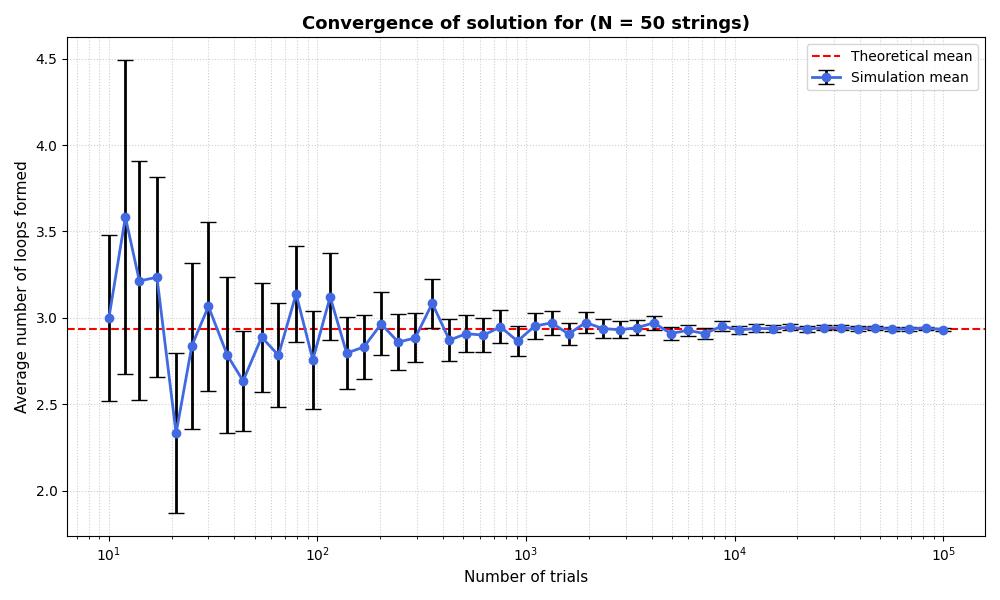
Furthermore, keeping the number of trials constant at 10,000, our theoretical solution agrees really well with simulations as you change the number of strings. Surprisingly, even at as low as
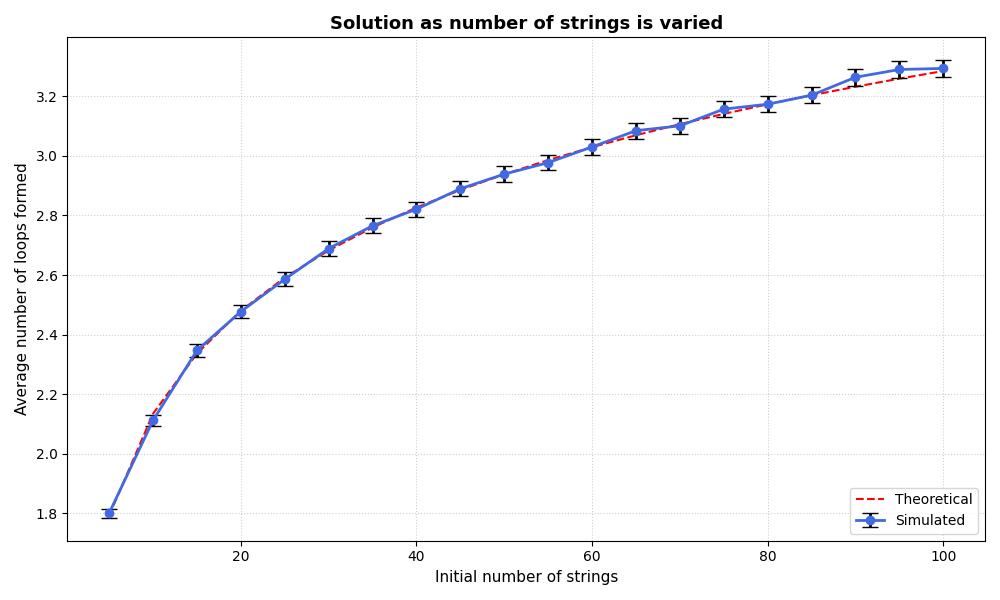
That's a wrap on this problem. A bit of fun looking at it from two different angles—theoretical and numerical—to be confident in our solution.