A Retrospective on The Elder Scrolls Adventures: Redguard
Since it's release in 2011, The Elder Scrolls V: Skyrim has played such a pivotal role in the cultural zeitgeist that it effectively defined what an RPG/action-adventure title even looks like. I'd argue that it wasn't until 2023 when Baldur's Gate III released that we saw a significant innovation in this type of title, although certainly it wasn't the only critical addition to the genre in the meantime. Regardless, everyone is waiting now to see what Bethesda is going to cook up with The Elder Scrolls VI. For better or for worse, it's going to define Bethesda the same way that Grand Theft Auto VI defines Rockstar.
Now, I am a big fan of retro video games and, in particular, old-school RPGs. It's a good time to investigate the origins of The Elder Scrolls, and I have a lot to say on the matter. The first two games in the series—The Elder Scrolls: Arena in 1994 and The Elder Scrolls II: Daggerfall in 1996—are in a lot of ways nearly a different series than what we would recognize as "The Elder Scrolls" franchise starting with The Elder Scrolls III: Morrowind in 2002. These first two games deserve a deep dive, one I'm not ready to get into today. Instead, what I want to investigate is one of the oft-forgotten spin-offs of the franchise: the 1998 action-adventure title The Elder Scrolls Adventures: Redguard.
I'm writing this post not just simply as a review of Redguard, although I will be sharing thoughts on the game and how it plays in 2026. What I really want to convince you of is something that I realized while playing Redguard: that this game was the moment the franchise became what fans recognize as "The Elder Scrolls" today.
The Gameplay
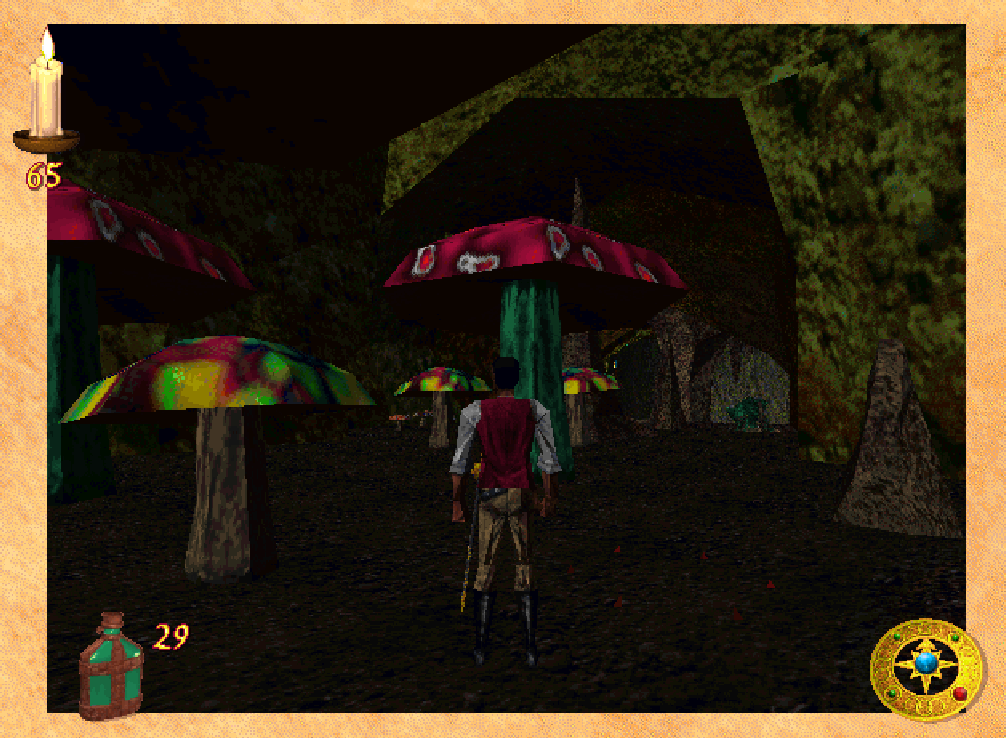
Unlike the mainline Elder Scrolls titles, Redguard is not a first-person RPG with action-adventure elements. Instead, this game is a third-person action-adventure game where you play as a pre-written character. There are no skills nor experience levels, and the gameplay is limited to a single hand-crafted island instead of the sprawling open-world provinces of the mainline games. The game is fully voice acted, something that will sound surprising to anyone used to Morrowind's later text-based dialogue.
At the time of Redguard, it was conceived that the Elder Scrolls franchise would feature three product lines: the mainline games would be known as "Classics," "Legends" would be about specific historical moments in Tamriel, and "Adventures" would be more adventure and character focused (see more info on the UESP). For the "Legends" line, we got the dungeon-crawler An Elder Scrolls Legend: Battlespire in 1997. Then came Redguard in 1998. Both sold poorly, and future planned installments for the "Adventures" line—Eye of Argonia and Paradise Sugar—never materialized, despite some minor hints for sequels in Redguard.
You end up with this odd duck of a game. It's a game that clearly wants to define a new direction for the series, to make the Elder Scrolls into a franchise instead of just a series of open-world RPG titles. But it's also a game that's completely unlike anything else in the series, and as a result there's no comparisons to be made.
For example, I have some difficulty discussing whether or not the combat system was a good choice for the game. Is it a good combat system? ...No. You can swing your sword, block, and strafe around opponents. You end up kind of awkwardly shuffling behind opponents while holding the block button to try to smack their back with your saber, and the camera will more often than not swing around you such that the enemy falls out of your line of sight. It's not difficult so much as clunky, and it fails to deliver on the swashbuckling pirate fantasy that the game promises.
But was the new combat a good choice for the series? Was it a step in the right direction? That's the question I have difficulty answering. It's a system that was, unfortunately, never iterated upon. I can identify some roots of something enjoyable here, something that could be improved upon. In fact, and this might be controversial, but I think swordplay in The Elder Scrolls VI might actually stand to benefit from looking in Redguard's direction! Skyrim has an infamously slippery melee combat experience. You swing a sword and it just kind of paddles an enemy until they ragdoll at death. I think some more dynamic swordplay involving slashes vs. jabs vs. blocks could be a fruitful ground for experimentation.
The healing mechanics are fine. There's no natural health regeneration; you have to use a health potion or pay the town priest to heal you. Redguard throws so much coin and potions at you that I never felt in danger so long as I entered combat at high enough health. There's two other potions in the game that provide defense and attack bonuses, but they aren't really all that useful. In fact, I guess there's supposed to be an in-game alchemy system, but I never once heard about it!
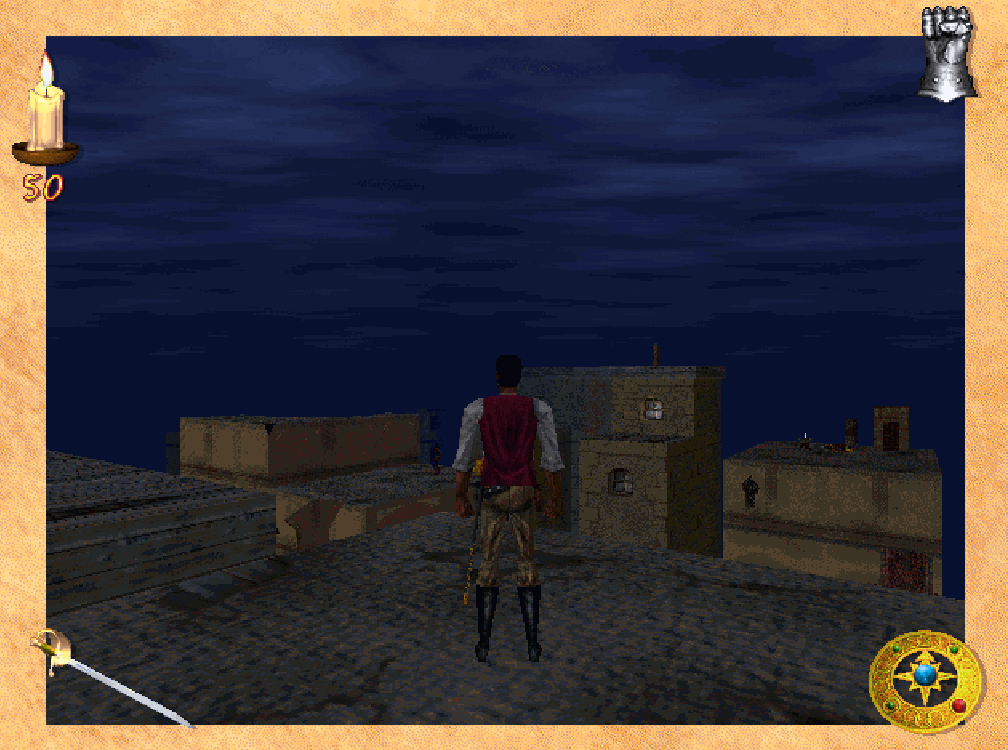
The game has an unusual difficulty curve. There are challenging portions of the game, but it's never consistent. You don't experience a direct ramp up in difficulty from the beginning of the game to its end. In fact, one of the very first major quests you complete turns all the patrolling guards in the game hostile to you. This makes exploration and walking through the town extraordinarily tedious, and I'm frankly shocked the development team stuck with this decision. It's really unfortunate that one of the primary sources of combat in the game exists primarily to slow the player down. Guards are going to be your number one enemy type in the game, and not by a small amount.
The RPG exploration in the game was very satisfying for me. I was able to play the game organically, without my eyes on the wiki to find the next quest (something I think is a little more difficult to honestly do in, say, Daggerfall). Only once did I have to consult the wiki to find the way forward. Otherwise, the game is pretty good at naturally directing you to the quests you need to think about. You need to talk to folks and pay very close attention to everything they say.
My favorite RPG experience was when I needed to find the password to the secret gambling den in town. Earlier, the silversmith told me that Lakene lost his wife's silver locket gambling with Rollo. Rollo won't give it up to me—I'll probably have to steal it from him, which I won't mind since he's a jerk—but I did find out from the general store owner that Rollo leaves his house to bring cargo from the docks when ships come in. Prnell (yes, his name is spelled "Prnell") waves the flag to signal the bell tower when a ship comes in; he will let me wave the flag if I find his eyepiece. He also told me he's friends with the bell tower operator, and that's where you'll spot his eye piece. It's a complicated chain of events in this quest, one that might overstay its welcome with some folks since it only involves talking. But I got a great sense of satisfaction when all the talking to the townsfolks paid off all at once!
I should briefly mention the soundtrack, which consists of merely seven songs and clocks in at 17 minutes. "Main Theme" is a jaunty, adventurous tune. "Valour & Honor" sticks out as a kind of upbeat battle/dungeon theme. You'll hear the other songs rotate out throughout the island, and boy will you become familiar with them. They're all fun and well-made, but they grate on the nerves by the end of your run. I ended up muting the game, tired of hearing the same songs. But I would nevertheless love to see the motifs from these songs make a reappearance in any future Elder Scrolls game taking place in Stros M'Kai.
A final note on the gameplay: the game is not stable. It's the kind of game that you'll want to be tapping the quicksave button often so that recovery from crashes doesn't sting so badly. The game is not optimized well, which led to very jumpy FPS even on a modern computer. There are apparently two graphical versions of the game, but I played with the original, low res version of the game through Steam. I wish all the success in the world to the Redguard Unity port for stability and gameplay enhancements, especially since Redguard isn't too large of a game.
The Story
To fans of the Elder Scrolls, you may be surprised to learn that Redguard does not take place in the Third Era of Tamriel, but actually in the Second Era during Tiber Septim's conquest of Tamriel. This age is famous for the formation of the Septim Empire that exists within all the mainline games (at least until Skyrim, taking place after a time jump of 200 years). Redguard takes place after a civil war in Hammerfell between the Crowns and Forebears. The Forebears gained a pyrrhic victory by allowing the Empire to take over Hammerfell in return for military support against the Crowns.
You play as Cyrus, a swashbuckling mercenary who is headed home to Hammerfell after many years away. Cyrus is arriving at the island of Stros M'kai to find his lost sister Iszara. Stros M'kai was the site of the recent defeat of the Crown Prince A'tor by Emperor Tiber Septim's dragon Nafaalilargus, and tensions between the defeated Crowns and Imperial Forebears remain high.
Does that sound like a lot of lore to dump on you all at once? I thought it was. It is also all delivered to the player in a single opening cinematic to the game. Complain all you want about the heavy-handed and lengthy Skyrim introductory sequence—at least the developers learned to show and not tell.
The characters of Stros M'kai are quite varied and unique. Cyrus is a daring, no-nonsense, sarcastic adventurer who hides a heroic heart underneath the veneer of a mercenary. It's funny to learn about his character as you play through his actions. Cyrus' interview with Provisional Governor Richton will always end in Cyrus mouthing off and earning a battle with the palace guards. There is no other outcome here, no way to sweet talk the governor into letting you go. Cyrus will be a smart-ass, and you, the player, will deal with the consequences.
The other main characters are also memorable. The voice acted characters are all quite developed personalities despite their short screentime, if a bit flat in development over the course of the story. There's the pompous Richton, the Provisional Governor of Stros M'kai. There's Tobias, your old Nord captain who hangs out at the tavern to offer you advice, his take on local politics, or to laugh about old escapades. There's a creepy-looking Sload necromancer named N'Gasta with permanently exposed gums. Mainline Elder Scrolls fans may recognize a recurring in-game esoteric book called "N'Gasta! Kvata! Kvakis!" authored by him. Sloads are fairly mysterious in the greater Elder Scrolls lore, so I was surprised that one just pops up as a character all the way back in Redguard. In any case, all these characters feel a bit to me like a game of Dungeons & Dragons, where your DM builds on some archetypal characters and throws a quirk or two on top to distinguish them.
The Book
By far the most interesting part of Redguard's contribution to the greater Elder Scrolls lore, though, isn't even found in the game itself. The game ships with a book (or pdf) called "The Pocket Guide to the Empire". This booklet is well-worth a read for anyone who is interested in the Elder Scrolls. It is a trove of world development.
The writers of this book (along with the major game developers for Redguard) are household names for serious Elder Scrolls fans. Todd Howard, Michael Kirkbride, Kurt Kuhlmann, Ken Rolston, and many others contributed significantly. The "Pocket Guide" really started the Elder Scrolls as we recognize it today. Kurt Kuhlmann even said that Redguard was his favorite game that he worked on!
Redguard is where we get a lot of deep lore about Tiber Septim. The game introduced soul gems, which feature a large part in the magic systems of all the later games. The specific accents that Khajiit and Argonians have, and their tendency to speak in third-person, started in Redguard. We first see the steampunk visual of Dwarven ruins in Redguard (although this would really be developed in Morrowind). There's so many bits of recognizable Elder Scrolls that can be traced back to Redguard. You'll even recognize some voice actors; the voice actor for Cyrus, Michael Mack, would go on to be the male Redguard voice actor in Morrowind and Oblivion.
The Elder Scrolls series before Redguard, back when Julian LeFay was the biggest single influence, was a procedurally generated dungeon-crawler. Those games are most reminiscent of other 90s-era CRPGs. But with Redguard, we see a turn in Bethesda's development towards hand-crafted worlds, with a bigger emphasis on world-building.
Conclusion
I hope that I've shown you that Redguard merits a little more credit within the Elder Scrolls community. I'm surprised it doesn't get much more discussion other than as a fun fact, that there are these oddball spin-off games that never went anywhere.
I don't think I'll play Redguard again, at least not any time soon. It's not a game that lends itself super well to replayability, and it's not a fantastically executed game, particularly in 2026. If you are a big fan of old-school RPGs and enjoyed Arena or Daggerfall, you'll want to take a look. In any case, I think that, for whatever else you may think about Redguard, its role as the initiator of the modern Elder Scrolls franchise should be recognized.